


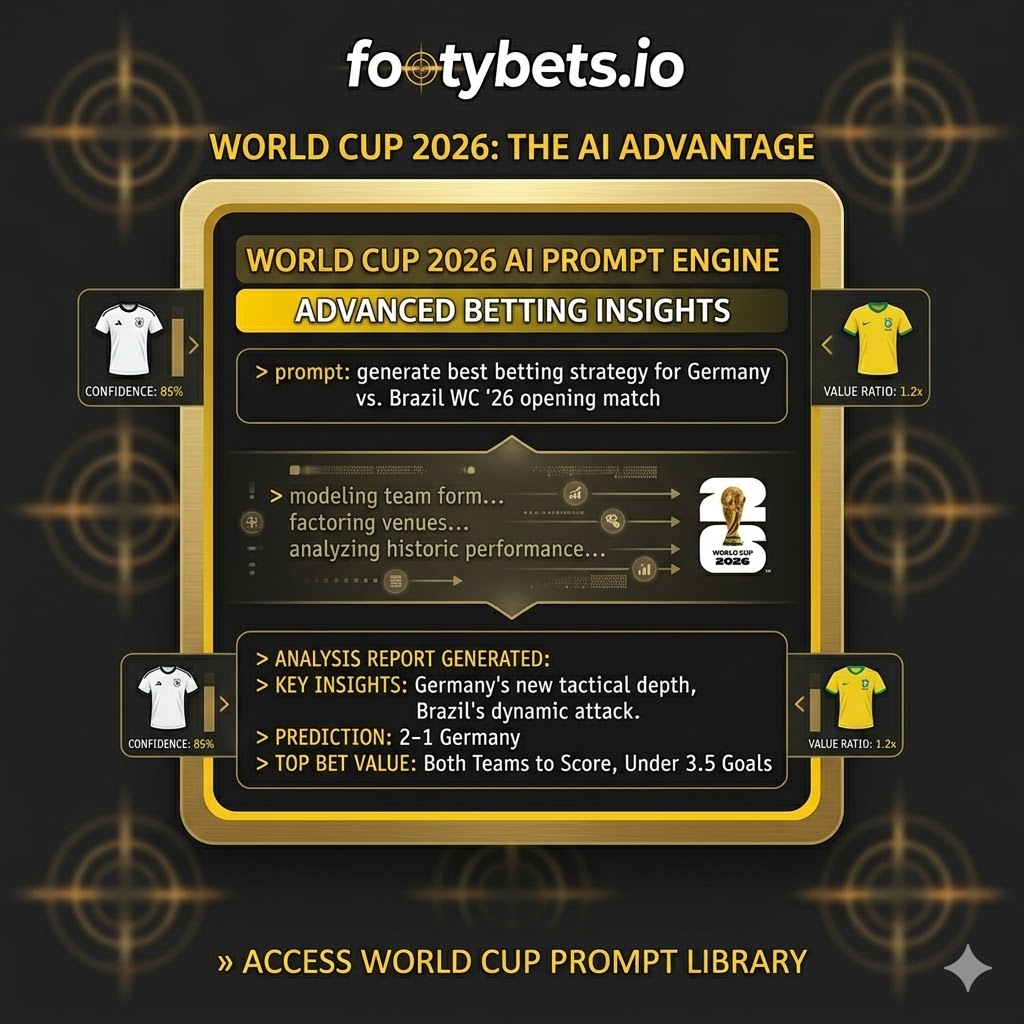

Most bettors waste potential profits during the 2026 World Cup simply because their AI prompts are too superficial. A precise tournament prediction is never down to luck, it depends entirely on the data you feed into the system. By providing detailed context, you can easily turn basic language models into a powerful betting assistant. In this guide, we show you how structured commands and interactive conversations secure your ultimate edge in World Cup AI betting.
What exactly is a prompt?
A prompt is a specific instruction or command you enter into an AI to trigger a desired response or action. The quality of your final output reflects how precise and detailed your input is, because the AI follows your instructions to the letter. A well-crafted prompt transforms a generic language model into a highly specialized tool tailored to your exact betting needs.
How to Use Artificial Intelligence for Perfect 2026 World Cup Predictions
Almost everyone uses artificial intelligence and language models like Gemini, ChatGPT, or Claude nowadays. For the upcoming 2026 World Cup in the USA, Canada, and Mexico, millions of fans will turn to these tools for tournament tips. Whether it is for friendly prediction leagues or serious sports betting, the temptation is massive. However, most users make one critical mistake: they ask questions that are far too simple.
If you just ask a machine who will win a match, you will get a surface-level response. The algorithms essentially guess by relying on generic historical statistics. For profitable sports betting or competitive World Cup pools, this provides zero advantage. The solution is straightforward but requires the right preparation.
The accuracy of an AI prediction depends heavily on the specific data included in your prompt.
The Power of Nuance in Data Input
What does a high-quality 2026 World Cup prediction actually require? It all comes down to the finer details. Take the travel fatigue of teams during the group stage: Algeria has to fly an incredible 4,800 kilometers back and forth between Kansas and San Francisco, crossing multiple time zones. Meanwhile, Egypt enjoys a relaxed 400-kilometer journey. Such distances heavily impact a player’s physical condition, and these specific stress factors must be fed into the AI’s instructions.
You also need to consider the team chemistry. Is there internal drama? What is the current form of key players? How strong is the individual quality across different positions? Even local weather conditions at the venue can change the outcome of a match. Furthermore, warm-up matches matter; you must tell the machine whether a team dominated against top-tier European sides or struggled heavily against weaker nations.
Provide the AI with Referee Stats and Table Standings
The match referee is another critical factor that is often overlooked. Is the official strict? Do they constantly disrupt the flow of the game with whistles? This data is vital for card bets, but it also alters goal counts. When a game lacks flow, fewer goals naturally follow.
The same logic applies to tactical setups and the current group standings. Does a team absolutely need a win on the final matchday? If so, they are forced to take massive risks. This opens up huge spaces for counterattacks and often results in a high number of corners. A vast web of stats and data ultimately dictates the success of a wager.
The Proof: How Drastically the Output Changes
To show you the massive difference between a vague and a detailed input, we tested a real example for the opening match of the 2026 World Cup: Mexico vs. South Africa. First, we asked a completely superficial question. Then, we used our highly detailed, verified dataset.
Avoid These Mistakes When Asking AI for World Cup Tips
- Vague questions: Asking „How will the game end?“ does not provide actionable data.
- Missing context: The AI does not automatically know the injury updates released this morning.
- No explicit directives: Give clear instructions, for example: „Analyze defensive vulnerability against counterattacks“.
- Lack of interaction: Treat the prompt as a starting point, not the final answer!
- Use follow-up questions to dig deeper and verify if the logic holds up.
How to Get Far More Valuable AI Predictions for the 2026 World Cup
- Assign a role: Give the AI an expert persona, such as: „You are a professional sports betting data analyst“.
- Provide a concrete data foundation: Feed the model with up-to-date facts including recent results, form curves, and injuries.
- Include qualitative factors: Take external influences like climate, travel fatigue, or fan pressure into account.
- Establish logical connections: Set guidelines for weighting data, such as: „Ignore historical data from 2010 and weight the last 5 games heavier“.
- Define clear goals: Specify exactly which betting market should be analyzed, like card stats, corners, or full-time score.
- Tailor the prompt to your goal: Referee stats are crucial for card predictions but mostly irrelevant for corner forecasts.
Our Ready-to-Use Templates for Every World Cup Match
No one has the time to sift through mountains of statistics before kickoff. That is why we handle the heavy lifting for you. On footybets.io, we provide fully optimized templates designed to query your AI for the best possible insights.
You will get a tailored prompt for every single World Cup match, whether you want to bet on the 1X2 market, goals, corners, or cards. Best of all, we update our texts daily. If a star player gets injured or a specific tactic becomes apparent, it is immediately built into the new command to ensure even more accurate AI predictions.
Additionally, we share our own final AI-generated World Cup bets with you, just in case you prefer to skip the chat with the artificial intelligence entirely.
Dialogue is the Secret to Success
We strongly advise our readers to keep the conversation going after the initial response. Simply copy our ready-made template and wait for the AI’s output. If you pick up a fresh piece of news in the meantime, just reply to the machine. For instance, you can type that a manager unexpectedly changed the formation this morning, and ask the system to adjust its previous prediction accordingly.
This continuous dialogue transforms the model into your perfect personal assistant. Use our templates as a solid foundation to unlock the maximum advantage for your 2026 World Cup AI predictions.